Friday, October 26, 2012

Cedars - the sequel

My friend, fiber artist Melinda West, sent me some additional pictures of yellow cedar, so I thought I would continue the thread I started yesterday with the Tale of two cedars. She also forwarded me a link to fiber arts magazine that showcases fiber art constructed from a mixture of yellow and red cedar.

This is the fallen yellow cedar from which she stripped bark on our incredibly steep hike up to Summerland.
fallen yellow cedar - Mount Rainier


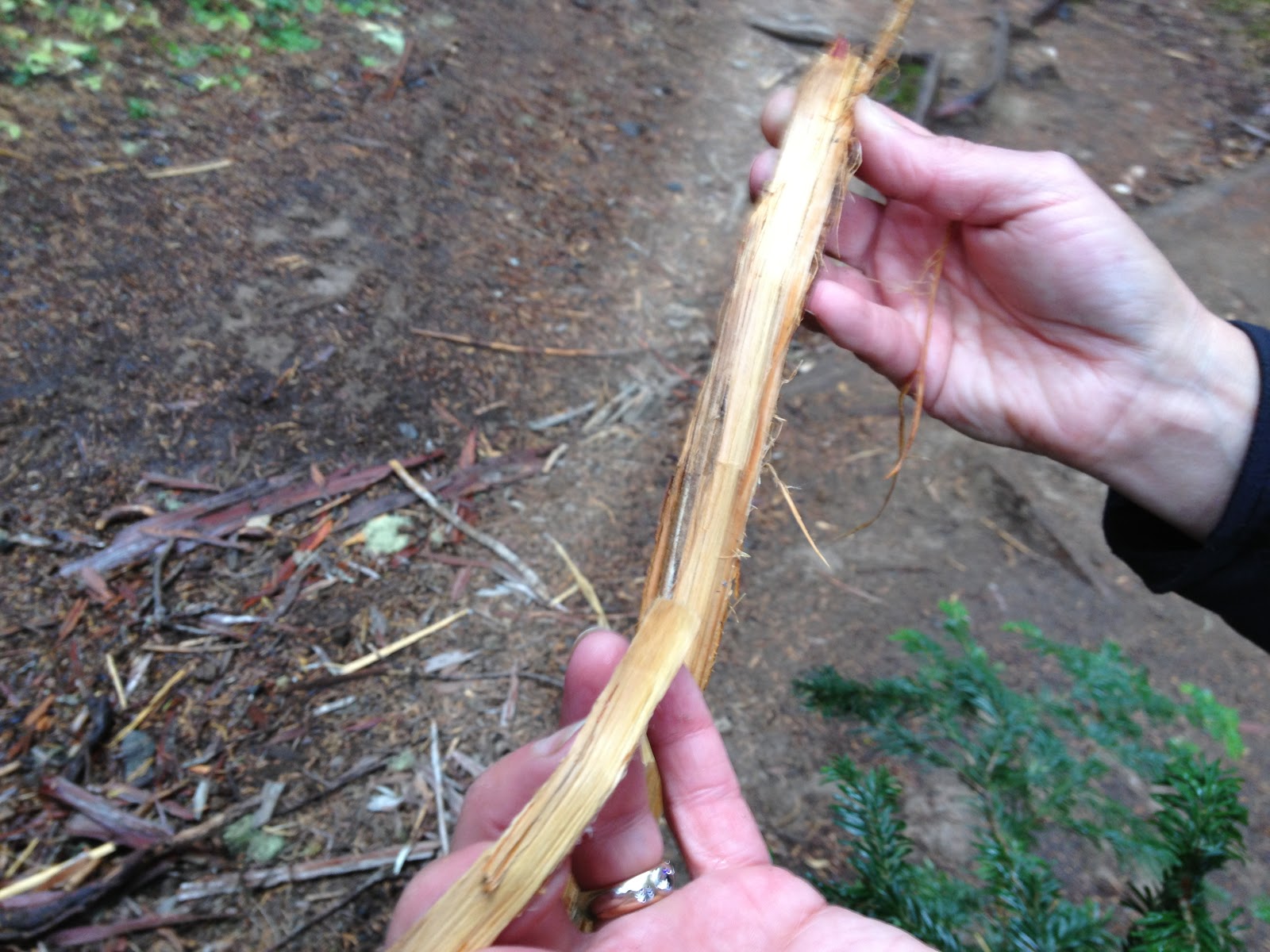
Melinda exposes yellow cedar inner bark
I mentioned in my previous posting that yellow cedar occurs in mountains of the Pacific coast. It ranges from Alaska to Northern California. Some sad news is that stands of Alaska Yellow Cedar are dying from root freezing due to global warming. Even though yellow cedar thrives in mountain temperatures, they are being killed by severe cold snaps early and late in the season. This is happening because of the absence of an insulating blanket of snow due to late snow fall and early snow melt resulting from climate change.

Yellow Cedar decline in Alaska
To close this sequel to cedars, I want to share a wonderful Nootka legend about the creation of yellow cedar or Nootka Cypress:

One day the trickster Raven encountered three young women drying salmon on the beach. He asked, "Aren't you afraid to be out here alone?'  "No", the women replied.  "Aren't you afraid of bears?", he asked. "No!!"  "Wolves?" "No!!"  Only when he asked about owls did they admit that they were frightened. For a joke, The Raven hid in the forest and made  owl sounds. The women were so terrified that they ran up the mountainside. When they ran out of breath the three women turned into Nootka Cypress trees. According to the Nootka, this is why Nootka Cypress grows on the sides of mountains and explains why the bark is silky like a woman's hair and the young trunk is smooth like a woman's body.


Wednesday, October 24, 2012

A tale of two cedars

Did you know that western red cedar is sometimes called  "nature's umbrella"? I've heard that in some native languages, the word for red cedar means the same as "dry underneath".  Besides keeping us dry on a wet, autumn walk, western red cedar, thuja plicata, remains the cornerstone of our northwest native culture. I was recently on  a wet mountain hike with northwest fiber artist and friend, Melinda West. She introduced me to a relative of our red cedar: Cupressus nootkatenses often called yellow cedar. She shared some similarities and some differences between the two "cedars".
western red cedar

Truth be known, neither species is a true cedar, but members of the cypress family. Yellow cedar is often called Nootka cypress. Our red cedar is generally found in our moist lowland forests. Yellow cedar, also a native of west coastal regions, occurs in wet sites in mountains often close to the tree line.

The two trees have similar sprays of flat foliage handing from drooping branches. They both are tall buttressing trees with relatively shallow roots. The bark of a red cedar can be described as fibrous or ridged - the yellow cedar can be easily called shaggy.


shaggy bark of yellow cedar


Historically both trees are life trees of the indigenous people of the northwest coast. The resilient and long lasting wood of the red cedar has traditionally been fashioned into poles, canoes, lodges and baskets. The wood of the yellow cedar is also prized by native peoples for its durability. While the red cedar is used for larger uses, yellow cedar historically was  used for clothing, smaller utensils and carvings. A Tlingit legend identifies the first Killer Whale being carved from Nootka cypress.
Melinda and I came across a fallen yellow cedar across our trail. The windfall was fresh enough for her to strip bark off of the tree.
Melinda West getting to the inner bark of a yellow cedar
 She then continued to strip the piece and get to the pliable inner bark. The yellow inner bark, she explained, is why this bark was so valued for early clothing. This inner bark is often easier to access than the inner bark of the red cedar. The inner bark was worked until it was felt-like. It offered a water tight material in which to fashion soft, comfortable, long lasting clothing and blankets. Even today we can see culturally modified trees, where bark has been stripped for age old uses. Melinda still uses materials from both trees to fashion contemporary works of art. Her gallery can be seen on her web page, www.melindawest.com.

Monday, October 8, 2012

October is for pumpkins and a new water year


 October is time for pumpkins and time to enjoy the beautiful fall colors. So far this has been the sunniest, cheeriest fall in recent memory. October is also the beginning of a new year - the water year.


Sunny weather is generally good news for folks. Since Kitsap depends on rainfall to replenish our aquifers, a freaky dry stretch gives water suppliers reason to be nervous. The last decent measurable rain was July 22 at .47 inches. Since then we  have had only a smattering of sprinkles. Check out the rain data on our web page to see for yourself.

What does this mean in terms of the 2012 water year that just ended? We are, amazingly, in good shape. This is due to an average rain year up until July -over 40 inches of rain before the dry spell. We also had a couple of great water years in 2011 and 2010 where we received 50 and 52 inches respectively. Aquifer levels are holding their own!

What will the new water year bring? Cliff Mass, UW meteorologist,says the high pressure ridge holding back the rain is leaving us on Friday resulting in some wet weather.  He also says that this is an El Nino year which usually translates to a dryer, warmer winter. He hedges his bets by also saying that it may be a "wimpy" El Nino that could bring snow and rain in late winter. The people watching precipitation rates in our office aren't predicting a thing, but, since our precipitation rates correlate with our aquifer levels, you can bet KPUD will be watching the upcoming water year carefully. Stay tuned.


Meanwhile, go out in the sun this week and look for some pumpkins.

Tuesday, September 18, 2012

Cistern at Kitsap Conservation District


 Brian Stahl from Kitsap Conservation District is hoping for rain. I stopped by the office this sunny September morning and got a tour of the Conservation District's on-site rainwater collection system. The cistern is empty at the moment and even though there isn't a cloud in the sky, Brian, is thinking about the winter rain water that will run off the building roof and fill up the 11,000 gallon tank. The water stored in the tank will flush the district building's toilets and, next summer, provide outdoor irrigation water.


11,000 gallon cistern
I immediately asked where he got such a huge tank. He told me that this rainwater collection system project started with a phone call from a small farm owner. He asked Brian if he could find a home for this good as new cistern that he couldn't use. The Conservation District offers assistance to landowners to protect natural resources, so Brian started asking around. When he got no takers, he decided to design a rainwater collection project at the office. The costs incurred fit nicely with a grant he received for rainwater collection.

filter and booster pump
This is how the project will work. The roof downspouts are all piped to a 1,500 gallon tank buried in the ground near the building. As soon as the 1,500 tank has reached its holding capacity, the rain water is pumped to the 11,000 gallon cistern.

Brian next to his electronics
 A submersible pump will send the water from the 1,500 tank to a filter.  The water will then be pumped directly to the district's irrigation system and to the building for flushing toilets. Brian is waiting for permits to connect the pipe into the building for the toilets.


Future connection to the inside toilets
 When the 1,500 gallon tank starts to drain; water from the large cistern will be gravity fed into this smaller tank to replenish the water. If the cistern becomes depleted, the toilet flushing will seamlessly revert back to well water.

If however, the huge cistern fills and overflows, the excess water will be channeled into the rain garden where the rain will make its way to the aquifer. The  rain garden has its own overflow system that has never been used.  Brian thinks this may be the year.

The rain garden closes the loop
Brian can hardly wait to watch the see-through tank gauge on the cistern fill with water. I think Brian would be glad to share his rainwater collection project with you. Contact him at the Kitsap Conservation District.

Wednesday, September 12, 2012

How much water to put on a new rain garden

KPUD's new Rain Garden must be kept watered until the plants are established. This could take a couple of years. This posed a question, how much water is enough? As a utility water conservation manager who is advising people to use water wisely, I needed to find out more. Marty, our hydrogeologist and I decided to approach finding out exactly how much to water scientifically and do the math.

First I had to find out how much water I was putting on the garden. I am watering with an ordinary fan type sprinkler that I got at the big box store down the road. It so happened that it's spray covers my approximately 23 square foot garden.
$9.00 sprinkler in the rain garden
 The rule of thumb is use one inch of water per week. Using a fancy sprinkler calibration system, I measured how long it took my sprinkler to water the garden this much. Homeowners can do this by doing the tuna can test.

accurate sprinkler gauge
I placed several  calibration cups through the garden. It took me a minute to figure out how this container measured only an inch, but it was pointed out by someone a little more savvy than me (Marty) that it was configured to offer a larger opening to allow the water to easily be collected.
 
calibration cups placed throughout the garden
I then turned on the sprinkler and let it run until .1 of an inch was collected. I determined that it took 20 minutes.I also determined that the sprinkler distributed pretty evenly throughout the garden. 
Marty looking at the cup measurement of .1 inch.

 Doing the math I calculated that it takes my sprinkler 3 hours and 10 minutes to get one inch to the garden!! Marty figured that multiplying the square footage of the garden by .62 gallons, It would take 328 gallons to arrive at my one inch per week.
(.62 gallons is the amount of water it takes to cover one foot of area with one inch of water.)
Alright, I decided, although letting the sprinkler run for three hours is counter-intuitive for a water conservation professional, I'll do it. Then  . . . .wait, it rained the other night. After running the sprinkler for half that time, I stopped it and got out my garden trowel.
I use a 4" garden towel to test if the soil is wet before I water
 The blade of my garden trowel is four inches. I gathered some soil from that depth.It was wet!! So, this is what I decided to do. Only run the sprinkler for 1 1/2 hours twice a week and test the soil for dampness before I water to see if it is necessary at all. Of course all bets are off if the plants are showing stress. This watering regime should keep the plants going until the winter rains take over in a month or so. I may have to continue watering another summer, but after that they will do just fine on their own.


Tuesday, September 11, 2012

Rain Garden Plants


Kitsap PUD has a new rain garden! I mentioned to Teresa Brooks from Kitsap Conservation District that our office needed one and it was no sooner said that done!

Teresa Brooks from Kitsap Conservation District getting ready to plant.
Rain Gardens collect rain water off of parking lots and driveways or any impervious surface. The rain garden contains a special mixture of soil that allows this water to slowly percolate into the ground rather than rush down the storm drains. Besides soil, the magic ingredient to the Rain Garden is plants.
 

Kerri Cechovic from Washington Enviroinmental Council digs right in.

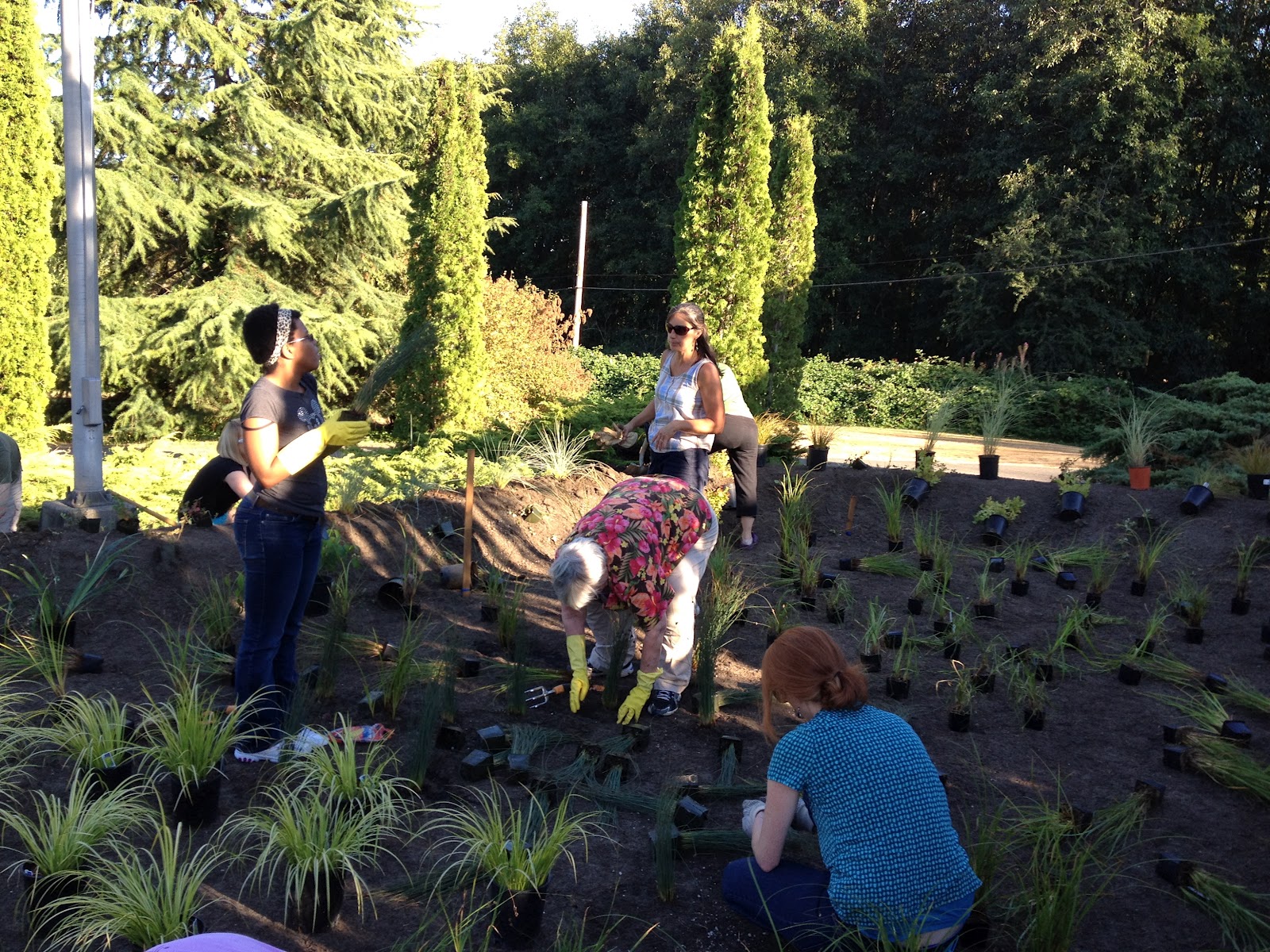
Jenny Morgan, Landscape Architect from the Conservation District, designed the Garden and its plant design. She and Teresa carefully set out the 480 plants. Kerri Cechovic from the Washington Environmental Council arrived. She was soon followed by seven local volunteers to help plant.


volunteers planting the garden


The Rain Garden is designed as a depression with room for six inches of water. Planted in  this area,  are plants that like wet feet, but can tolerate completely drying out during the summer. These plants are slough sedge, small fruited bullrush, baby blue eyes and iris.

The finished rain garden

Along the outside edges are dought tolerant plants that won't need watering once established. They include rudbeckia, Nepeta Walker Low, Heuchera, Geranium Biokova and a few Spiraea Magic Carpet and some low growing Dogwoods.

Hannah, the youngest volunteer planter
 KPUD appreciates help from Teresa and Jenny from the conservation district and, especially appreciates the volunteers who came to plant  on a hot evening in September.

Teresa has a goal of 1,000 Rain Gardens in Kitsap. She even has $500 to match each homeowner's cost of building one on their property. Contact Teresa for more information.

Wednesday, March 28, 2012

Kitsap Schools Fly the Washington Green Schools Flag


Research has determined that 82% of what we learn comes from doing. What better place to learn to be environmentally responsible than school! That is why Washington Green Schools is such a successful program. Washington Green Schools is a non-profit that supports schools to become more sustainable, energy efficient, waste conscious and water wise. Students are engaged in making sure that their schools walk the talk.

This is the process to become a Green School.

  1. Schools create a Green Team and sign up on the web page.
  2. The team chooses a category for the school year from five program levels. They choose from: Energy, Healthy School buildings, Transportation, Waste and Recycling and Water.
  3. The team earns points in their category. These points are attained by assessment, makings a lasting change in that category, evaluating the process and sharing what students learned with others. They follow checklists and materials found on the web page. 
  4. Schools receive Green School certification and Green Schools Flag is presented to them at an assembly.

teachers display the flag!
Island School on Bainbridge Island proudly displays the Green School Flag! They are on their second level! Their first category was recycling. This year they chose water.
The students assessed their water use and learned how to conserve water. They even created a DVD called “Brush your teeth”, a drama about turning off the tap when you brush.

KPUD as a sponsor of Washington Green Schools, participated in a school wide round robin water cycle assembly at Island School. The kids followed the path of a rain drop and learned about groundwater recharge, storm water runoff and how to use safer products to protect our watersheds.

It is the mission of Washington Green Schools that every school in Washington will teach, model, and practice environmental sustainability, serving as centers for change throughout the region. We in Kitsap are on our way with eight schools taking the Green Schools challenge. Learn more about this program at the Washington Green Schools web page.