Thursday, January 31, 2013

Peter Senge Speaks at the E3 Statewide Summit


Last week at the E3 Washington statewide summit; teachers, businesspersons and environmental educators were given the opportunity to attend a presentation by Peter Senge.  Peter Senge is a MIT professor, and author of the Fifth Discipline. Peter’s relevant topic was building community through collaboration. True collaboration is strategic – members need each other. I took away several key points about collaboration and convening groups with diverse members.

Empathic listening
Peter quoted one of his students as defining listening as what he did while he was waiting to talk. Who is not guilty of this? What’s more, Peter points out that most of what we think we hear is not what is being said at all. It is the human condition, neither right nor wrong, to filter what we hear through our emotions. Peter suggests that we ask ourselves what is triggering our responses to what others are saying. Instead of arguing or checking out, Peter recommends that we ask for clarification. Use inquiry rather than advocacy.

Dialogue
Peter put forth the difference between discussion and dialogue. He describes discussion as being a ping pong game of volleying opinions.. Peter suggests that we strive for dialogue.  Peter explained that the word, dialogue, means “flow of meaning”. Replacing discussion with dialogue means engaging in inquiry based information sharing that result in better understanding between members.

Community building through practice
Peter ended the presentation with some practical guidelines for convening diverse groups.
  • Ask who is not at the table and who needs to be included.
  • Use the World CafĂ© method of seating participants at small tables conducive to conversation.
  • Check in with participants at the beginning and the end of meetings.
  • After a group decision has been made, ask what qualms members have about the decision. This “qualming” exercise can hint at problems that may come up in the future.
  • Peter finds it valuable for members to take “learning journeys” together for first hand experiences. Traveling there and back offers time to process and learn from different viewpoints.
  • Peer shadowing is another technique that Peter uses. Watching each other deal with day to day events illuminates others positions.
Striving for true collaboration using Peter’s guidelines offers a fresh and useful approach to community building between diverse members.  Thanks to E3 for bringing Peter Senge to the E3 State Summit.


Tuesday, January 22, 2013

Washington Cooperative Conservation Report Issued

The Partnership for Water Conservation has released a first ever report summarizing the activities of water conservation efforts by municipal water suppliers in Washington. Since the passage of the Municipal Water Law in 2003, water suppliers with more than 15 connections must implement conservation programs and track their progress toward greater water use efficiency. This report is important as Washington is one of the few states with water use efficiency rules in the nation.

The Partnership for Water Conservation is a nonprofit 501(c)(3) organization dedicated to enhancing water efficiency in Washington. The Partnership's Cooperative Conservation Report was written by a diverse team of Partnership members.This report analyses data collected from 153 utilities responding to water use efficiency regulations set forth by the Municipal Water Law. The analysis shows that billions gallons of water have been saved since the implementation of the law and that cost effective conservation opportunities are still available to utilities.

Read Cooperative Conservation: A Report on the Implementation of Washington's Water Use Efficiency Rule to learn about analysis of system leakage, conservations measures, water metering and the setting of water use efficiency goals.

I had the honor, as 2012 Chair of the Partnership Board, to present the team the Partnership 2012 Leadership Award for the completion of this report at the Partnership Membership meeting on January 10. Sincere gratitude goes to out to all involved in collecting data, researching, writing and editing this important product.
Debbie presenting award to Committee Chair Dan Muir

Friday, January 18, 2013

Partnership for Water Conservation Leadership Award

Debbie accepts the Partnership for Water Conservation 2012 Leadership Award.


I proudly accepted the 2012 Leadership award from the Partnership for Water Conservation at its quarterly membership meeting on January 10 at Bellevue City Hall. The Partnership is a nonprofit made up of over 80 water utilities, businesses and non-profits. The interests of the Partnership surround water resource stewardship. I have had the pleasure of serving on the Board for several years. During 2012 I served as Board Chair.


My award is for my role in the process of completely reorganizing the Partnership - top to bottom. I got the award, but thanks really goes out to the wonderful folks making up the 2012 Board. I had the pleasure working with seven committed Board members who formed the structure of Partnership 2.0.


Earlier this year, it became apparent that the mission of the Partnership was being outweighed by administrative responsibilities. When looking at ways to better serve our members, we decided to streamline the Partnership, making it a much more simple and user friendly organization. The Board identified that the Partnership exists to provide networking, collaboration and communication between diverse members to promote stewardship of water resources in Washington. We want the initiatives of the organization to come from the expressed desires of the members not the Board of Directors.


To best fulfill the purpose of the Partnership, we now hold quarterly networking meetings for our diverse members. Each meeting will include a presentation on a subject important to them. Opportunities for Partnership funded and sponsored projects will be identified and sought out from the members. The five member board acts as a steering committee to schedule quarterly meetings and facilitate the accomplishment of chosen projects.


I turned the chairperson gavel over to Mike Brent for the upcoming year, but the Partnership for Water Conservation has been turned over to the membership. This award will remind me of this eventful year and how we met our organizational challenges
.


Friday, November 30, 2012

PUD Rain Garden: It works!

 
PUD's rain garden has been getting a work out in past weeks. This is the October 31 storm. Notice the pipe that channels the excess water under the garden to the storm drain. The gravel is a pathway for water from even larger storms, which we experienced this month.
 

This is the beginning. Teresa Brooks and Brain Stahl from the Kitsap Conservation District are surveying the area for the raingarden. The rain garden will be 10% of the impervious surface area that drains to it.
 
 
This spot was chosen because water from the parking lot naturally flows toward this area as you can see by the weather worn curb.
 
Let the digging begin. This is our own Jason Thorne is running the excavator. The old bushes were removed and hauled away.  A berm was created to form a depression 18" deep.
 
A mixture of compost and sand was added. The bottom had to be perfectly leveled.
 
An overflow pipe was connected  to the existing storm drain.
 
A new curb was in order, creating an inlet for the sheeting rain from the parking lot.
 
Look at that perfectly sculptured rain garden ready for planting.
 

After the rain garden was planted, Our guys created an asphalt "speed bump" across the driveway to guide rain water into the garden.
 
Our rain garden slows down the storm water that runs off the parking lot. It absorbs and cleans water that would have rushed down the storm drain and into the Puget Sound.  


Friday, October 26, 2012

Cedars - the sequel

My friend, fiber artist Melinda West, sent me some additional pictures of yellow cedar, so I thought I would continue the thread I started yesterday with the Tale of two cedars. She also forwarded me a link to fiber arts magazine that showcases fiber art constructed from a mixture of yellow and red cedar.

This is the fallen yellow cedar from which she stripped bark on our incredibly steep hike up to Summerland.
fallen yellow cedar - Mount Rainier


Melinda exposes yellow cedar inner bark
I mentioned in my previous posting that yellow cedar occurs in mountains of the Pacific coast. It ranges from Alaska to Northern California. Some sad news is that stands of Alaska Yellow Cedar are dying from root freezing due to global warming. Even though yellow cedar thrives in mountain temperatures, they are being killed by severe cold snaps early and late in the season. This is happening because of the absence of an insulating blanket of snow due to late snow fall and early snow melt resulting from climate change.

Yellow Cedar decline in Alaska
To close this sequel to cedars, I want to share a wonderful Nootka legend about the creation of yellow cedar or Nootka Cypress:

One day the trickster Raven encountered three young women drying salmon on the beach. He asked, "Aren't you afraid to be out here alone?'  "No", the women replied.  "Aren't you afraid of bears?", he asked. "No!!"  "Wolves?" "No!!"  Only when he asked about owls did they admit that they were frightened. For a joke, The Raven hid in the forest and made  owl sounds. The women were so terrified that they ran up the mountainside. When they ran out of breath the three women turned into Nootka Cypress trees. According to the Nootka, this is why Nootka Cypress grows on the sides of mountains and explains why the bark is silky like a woman's hair and the young trunk is smooth like a woman's body.


Wednesday, October 24, 2012

A tale of two cedars

Did you know that western red cedar is sometimes called  "nature's umbrella"? I've heard that in some native languages, the word for red cedar means the same as "dry underneath".  Besides keeping us dry on a wet, autumn walk, western red cedar, thuja plicata, remains the cornerstone of our northwest native culture. I was recently on  a wet mountain hike with northwest fiber artist and friend, Melinda West. She introduced me to a relative of our red cedar: Cupressus nootkatenses often called yellow cedar. She shared some similarities and some differences between the two "cedars".
western red cedar

Truth be known, neither species is a true cedar, but members of the cypress family. Yellow cedar is often called Nootka cypress. Our red cedar is generally found in our moist lowland forests. Yellow cedar, also a native of west coastal regions, occurs in wet sites in mountains often close to the tree line.

The two trees have similar sprays of flat foliage handing from drooping branches. They both are tall buttressing trees with relatively shallow roots. The bark of a red cedar can be described as fibrous or ridged - the yellow cedar can be easily called shaggy.


shaggy bark of yellow cedar


Historically both trees are life trees of the indigenous people of the northwest coast. The resilient and long lasting wood of the red cedar has traditionally been fashioned into poles, canoes, lodges and baskets. The wood of the yellow cedar is also prized by native peoples for its durability. While the red cedar is used for larger uses, yellow cedar historically was  used for clothing, smaller utensils and carvings. A Tlingit legend identifies the first Killer Whale being carved from Nootka cypress.
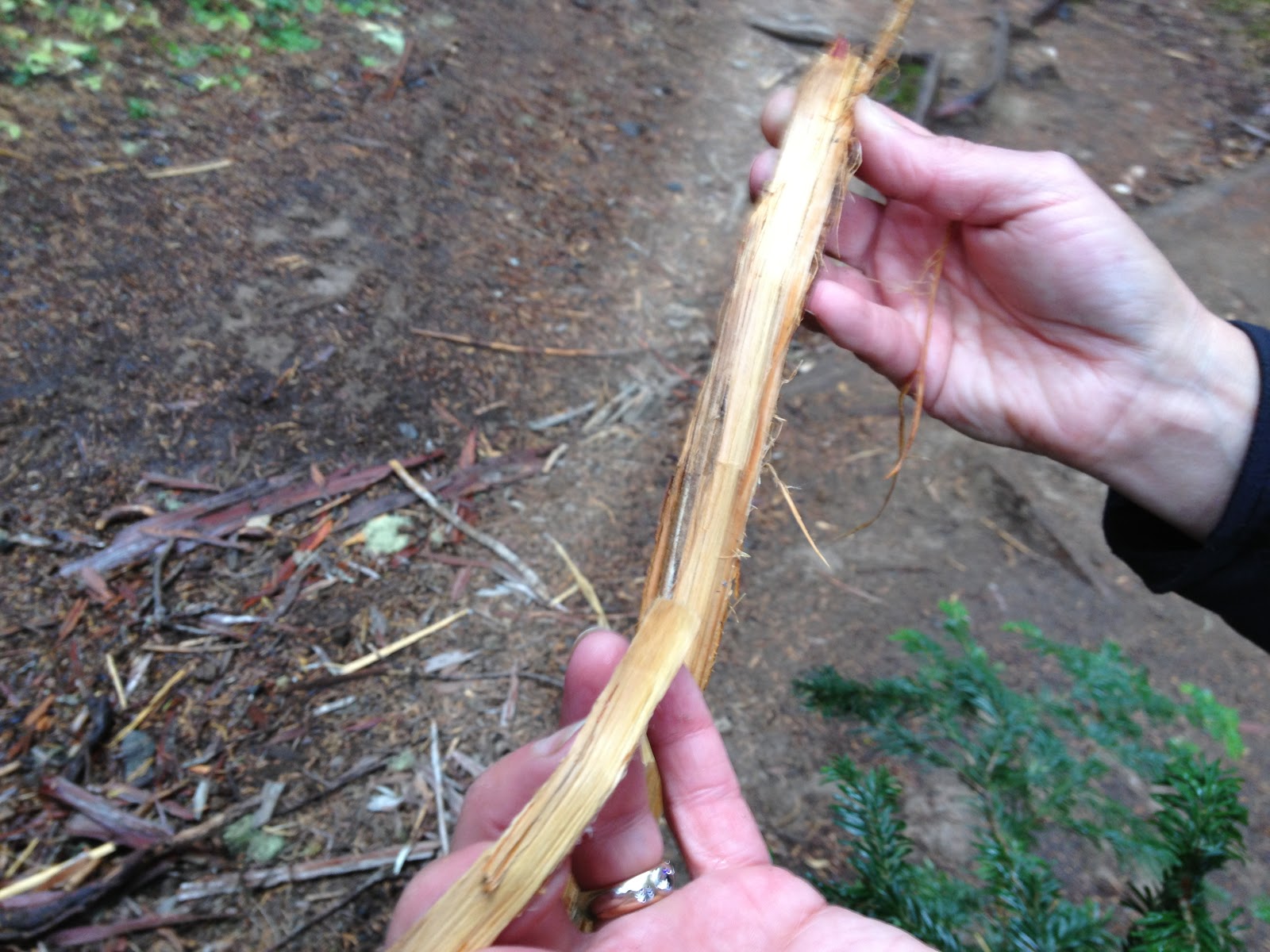
Melinda and I came across a fallen yellow cedar across our trail. The windfall was fresh enough for her to strip bark off of the tree.
Melinda West getting to the inner bark of a yellow cedar
 She then continued to strip the piece and get to the pliable inner bark. The yellow inner bark, she explained, is why this bark was so valued for early clothing. This inner bark is often easier to access than the inner bark of the red cedar. The inner bark was worked until it was felt-like. It offered a water tight material in which to fashion soft, comfortable, long lasting clothing and blankets. Even today we can see culturally modified trees, where bark has been stripped for age old uses. Melinda still uses materials from both trees to fashion contemporary works of art. Her gallery can be seen on her web page, www.melindawest.com.

Monday, October 8, 2012

October is for pumpkins and a new water year


 October is time for pumpkins and time to enjoy the beautiful fall colors. So far this has been the sunniest, cheeriest fall in recent memory. October is also the beginning of a new year - the water year.


Sunny weather is generally good news for folks. Since Kitsap depends on rainfall to replenish our aquifers, a freaky dry stretch gives water suppliers reason to be nervous. The last decent measurable rain was July 22 at .47 inches. Since then we  have had only a smattering of sprinkles. Check out the rain data on our web page to see for yourself.

What does this mean in terms of the 2012 water year that just ended? We are, amazingly, in good shape. This is due to an average rain year up until July -over 40 inches of rain before the dry spell. We also had a couple of great water years in 2011 and 2010 where we received 50 and 52 inches respectively. Aquifer levels are holding their own!

What will the new water year bring? Cliff Mass, UW meteorologist,says the high pressure ridge holding back the rain is leaving us on Friday resulting in some wet weather.  He also says that this is an El Nino year which usually translates to a dryer, warmer winter. He hedges his bets by also saying that it may be a "wimpy" El Nino that could bring snow and rain in late winter. The people watching precipitation rates in our office aren't predicting a thing, but, since our precipitation rates correlate with our aquifer levels, you can bet KPUD will be watching the upcoming water year carefully. Stay tuned.


Meanwhile, go out in the sun this week and look for some pumpkins.